Russian Revolution
Doctor ZhivagoThe Russian Revolution is portrayed not as a clean passage from one settled order to another, but as a rupture that enters daily life while people are still trying to live it. Across military collapse, institutional reorganization, displacement, and later political repression, the novel sets revolutionary promises against the damage of coercion and enforced belief. Yurii Andreievich Zhivago’s reflections give that history a larger frame: political upheavals are visible shocks, but society itself changes more slowly, like a forest growing beyond the eye’s ability to follow it.
Rupture in Everyday Life
The revolution arrives without the orderly beginning its advocates might have imagined. In a conversation about the new era, the transformation is praised for cutting away centuries of injustice; its startling force, however, lies in beginning in the middle of ordinary life rather than after a deliberate clearing of the ground. The passage frames revolution as an event that interrupts the ongoing course of daily existence, not as a new chapter that waits for life to pause before it starts.
The seasons give that rupture a longer and more complicated duration. The winter following the upheaval is already dark, hungry, and cold, and the next two winters intensify the same struggle to hold on to life as familiar conditions break apart. The narrative notes that events assigned to 1917 and 1918 may actually belong to later moments: the three winters have merged in memory. This blurred chronology makes social collapse felt as a sustained period of hardship rather than a neatly bounded episode.
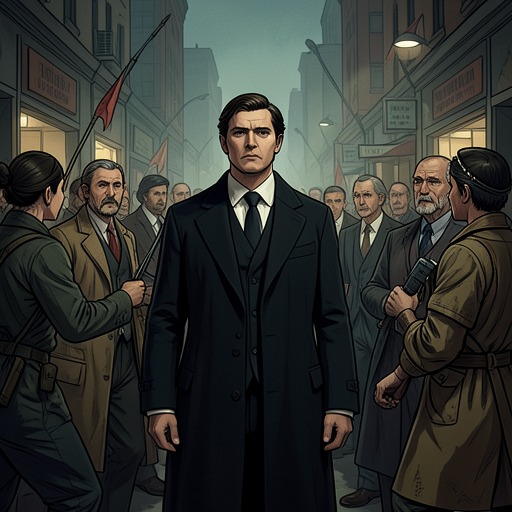
At first, the old life and the new order stand apart rather than openly fighting. Their incompatibility is already apparent, but the civil war’s direct hostility has not yet begun. Meanwhile, elections and reorganizations spread through buildings, offices, public services, and organizations; commissars with dictatorial powers are appointed, and enterprises are brought under Bolshevik control. The revolution’s abstract claims thus become concrete changes in authority and administration, before those changes can be reconciled with the habits and needs of ordinary life.
Institutions, Ideology, and Conscience
The novel’s account of political transformation includes both revolutionary enthusiasm and institutional coercion. In an earlier military crisis, a planned offensive is accompanied by efforts to improve morale, the creation of revolutionary courts-martial, and restoration of the death penalty. In another scene, Commissar Gints addresses surrounded soldiers about duty and the fatherland, then threatens them with death if they refuse to disarm and surrender their leaders. The contrast between official language and the listeners’ exhaustion shows how political appeals can lose force when they arrive as commands backed by punishment.
The reorganization reaches the Hospital of the Holy Cross, renamed the Second Reformed. Some staff members leave or are dismissed; doctors who depart for their own interests present their choice as a civic protest and look down on those who remain. Zhivago stays, even as political groupings regard him as insufficiently aligned with either side. His medical work also includes compiling statistics on mortality, illness, staff earnings, political participation, elections, and shortages of fuel, food, and medicine. The forms register how thoroughly institutional life has become a subject of administrative measurement, while his private writing records a different concern: people seem to have stopped being themselves and to be acting unfamiliar roles.
That concern becomes an explicit diagnosis of ideological conformity in Larisa Feodorovna Antipova’s account of her marriage to Pavel Pavlovich Antipov. She traces a generation’s misfortunes to the war and the breakdown of ordinary moral expectations, but identifies a further social injury in the loss of confidence in one’s own judgment. People begin to distrust their moral sense and to repeat notions imposed on them, first under the Tsarist order and then in revolutionary language. Even domestic conversation becomes affected: artificial, self-conscious talk replaces the couple’s former spontaneity. Pavel mistakes this wider social falsehood for a private failure in himself, and the misreading helps explain the painful consequences in their marriage.
Revolution and the Shape of History
Zhivago’s thoughts on history resist the idea that rulers or military leaders simply make it. He imagines social change through the growth of a forest: winter leaves the branches bare, then spring transforms the landscape with a speed that cannot be directly watched. From an observer’s limited perspective the woods appear still, although growth continues. History, likewise, changes incessantly while seeming motionless; wars and revolutions are agents within that larger process, not its sole authors.
This distinction complicates the apparent triumph of revolutionary action. Fanatical actors may overturn an old order in hours, days, or weeks, and the spirit that drives them may be revered for decades or centuries. Yet the scale and speed of visible upheaval should not be confused with the deeper, less visible movement of social life. In mourning both for Larisa Feodorovna and for an earlier summer in Meliuzeievo, Zhivago recalls a moment when people’s lives seemed to exist for themselves rather than serve as illustrations of a superior political thesis. His grief connects personal loss to the loss of a social world in which individual experience had not yet been subordinated to a single interpretation.
The novel’s attention to history is also formal. Zhivago writes medical notes, a gloomy journal combining prose and verse, and later reflections on nature and society. These different forms coexist with letters and remembered conversations, so political history is encountered through private records and individual voices rather than through a single authoritative account. When he reads Tonia’s delayed letter in Larisa Feodorovna’s house, its news of a daughter and the family’s deportation from Russia draws him away from his immediate surroundings. The political event is therefore registered not only as a change of regime but as a reordering of family life, memory, and attention.
From Revolutionary Promise to Later Repression
The revolutionary moment does not, in the novel’s account, end when its direct forces recede. A later reflection on the 1930s argues that collectivization was an unsuccessful measure whose failure could not be openly admitted. The effort to conceal it required terror and the suppression of independent judgment, including pressure to deny what people could see for themselves. The constitution and elections are described as forms whose apparent guarantees conflict with their actual operation. The criticism is directed not merely at hardship, but at a political order that demands people affirm an account they know to be false.
In that later recollection, the outbreak of war brings relief of a paradoxical kind. Its real danger and possibility of death seem preferable to a public life governed by what the speaker calls an inhuman reign of falsehood, because the emergency breaks the spell of official language. The war is also understood as a later link in the chain of revolutionary decades: not the direct continuation of the revolution’s original forces, but a consequence of consequences, made possible by the ordeals that have shaped people. The claim does not erase the cost of war. It holds together the deaths and losses of the conflict with the moral courage that suffering has brought into view.
The effects of this history become literal in the lives of children. Misha Gordon reflects that an ideal can decline into crude materialism, comparing the Russian Enlightenment’s transformation into the Russian Revolution with Greece’s passage to Rome. He then revises a figurative account of a generation as the children of terrible years: in the new reality, children are children, and the terrors are truly terrible. The shift from metaphor to lived fact concentrates the novel’s historical judgment. Revolutionary language may make a generation sound symbolic, but its consequences are inherited by actual people.
Aftermath and Narrative Significance
When the doctor and Vasia Brykin return to Moscow in the spring of 1922, at the beginning of the New Economic Policy, the city is diminished but not lifeless. The limited restoration of private trade brings small-scale dealings and speculation without creating new wealth or relieving the city’s squalor. At the same time, owners of modest private libraries establish a cooperative bookshop in an empty shop. The modesty of these details sets survival and cultural continuity beside the larger political transformation: everyday initiative persists, but within narrowed material circumstances.
Zhivago later describes Moscow as deserted and partly destroyed, with a diminished population and old buildings left in disrepair. Yet he insists that the city remains modern and that cities are the source of inspiration for new art. Its apparent jumble of impressions is not merely a stylistic trick: like the swift sequence of images in a poem, urban life brings together crowds, vehicles, and changing forms of movement. The revolution’s damaged city is therefore at once evidence of historical loss and a source of new artistic perception.
The novel finally resists reducing the Russian Revolution to either a promise fulfilled or a disaster with no remainder. Revolutionary reorganization can embody a break with entrenched injustice, yet its institutions can also impose new authority; the ideal of social emancipation can decay into coercive materialism. Against both the fantasy of a perfectly planned beginning and the claim that one leader directs history, the narrative places individual judgment, intimate bonds, creative work, and the slow growth of social life. Its account of revolution remains unsettled because those forces continue to outlast any single political proclamation.